- Interactive reports provide an integrated view of a person's biomedical and psychological (body-mind) information, which improves decision-making by addressing the needs of the "whole person."
- Medication assessment tool that identifies possible drug-drug interactions and adverse side effects, as well as offering recommendations for oneself and one's healthcare provider
- Personalized desktop portal providing easy access to relevant information on the Internet and elsewhere.
- Problem-management guides providing coping and problem-solving tools that include gateways to focused information related to troubling issues a person is facing; this process helps avoid overload by supplying information and interpretations in the context of real-life situations.
- A diabetes data collection and reporting module, which provides a convenient way to input data about blood glucose and hemoglobin A1c levels, insulin use, exercise, blood pressure, cholesterol, and mental stress. It also calculates your body mass index (BMI) and generates a series of charts and graphs showing changes over time. Note that we will be building other specialized modules for other chronic conditions.
- A way to give the individual complete control over the data by enabling him/her to determine whom (if anyone) has permission to view each particular piece of information, which allows data sharing in a very protective manner.
- The ability to generate "composite reports" containing information from multiple sources. To demonstrate this, several additional files are included with the beta version. One is an XML-based Continuity of Care Document (CCD) and the other is a data file from a diabetes health education program that was generated by a web-based database. The software automatically retrieves data from both files and includes them in a demo Profile report, along with data that has been manually entered using the PHPro data entry forms.
- A method for indexing and categorizing every conceivable piece of health-related information using a convenient numeric classification system similar to Dewey Decimal, which libraries use to organize books.
- A comprehensive, ever-evolving, self-assessment questionnaire that speeds knowledge-building through a patented process that uses sophisticated branching logic to administer to an individual only the assessment items relevant to him/her.
- The ability to enter time-sensitive data in any order and have it appear chronologically.
- An innovative, secure, low-cost patented system for sharing health information in peer-to-peer (decentralized) networks.
Tuesday, February 10, 2009
Personal Health Profiler – Beta testing has begun
I'd like to announce that our Personal Health Profiler (PHPro) beta has just begun formal field testing. I expect to release it for public examination later this month. Here's what the PHPro beta currently includes:


Sunday, January 25, 2009
Consumer-Centered Cognitive Support through Clinical Decision Support
Two things have been merging in my mind:
In an effort to clarify my thoughts, I've begun composing the following PowerPoint presentation defining CSS and CDS, and the intersection between them. I'll have more to say about this in future posts.
Click an image to enlarge it.


- A preliminary report released two weeks ago by the National Research Council of the National Academies titled "Computational Technology for Effective Health Care: Immediate Steps and Strategic Directions." In my previous post, I discussed how this report criticizes the bulk of today's health information technologies and offers recommendations for innovative (disruptive) technologies. Included in the report is a call for the invention of a new type of software program that offers "Consumer-centered Cognitive Support (CCS)" (also known as Patient-Centered Cognitive Support (PCCS). CSS consists of computerized methods that assist healthcare providers and consumers in making better decisions and taking more competent actions.
- A webinar presented last week by the Agency for Healthcare Research and Quality (AHRQ) National Resource Center for Health IT, titled "A National Web Conference on Evaluating Measures of Success Using Clinical Decision Support." The presenters discussed current day "Clinical Decision Support (CDS)" software systems, which are still in their infancy and are designed to assist healthcare providers and consumers in making better decisions and responding more competently.
In an effort to clarify my thoughts, I've begun composing the following PowerPoint presentation defining CSS and CDS, and the intersection between them. I'll have more to say about this in future posts.
Click an image to enlarge it.


Sunday, January 18, 2009
National Research Council Report: How to Fix What’s Wrong with Today’s HIT
As recently discussed on The Health Care Blog, the National Research Council of the National Academies released a draft report titled "Computational Technology for Effective Health Care: Immediate Steps and Strategic Directions," which criticized the bulk of today's health information technologies (HIT) and offered their advice. The following quote summarizes the Council's primary conclusion:
In short, the nation faces a health care IT chasm that is analogous to the quality chasm highlighted by the IOM over the past decade. In the quality domain, various improvement efforts have failed to improve health care outcomes, and sometimes even done more harm than good. Similarly, based on an examination of the multiple sources of evidence described above and viewing them through the lens of the committee's judgment, the committee believes that the nation faces the same risk with health care IT—that current efforts aimed at the nationwide deployment of health care IT will not be sufficient to achieve the vision of 21st century health care, and may even set back the cause if these efforts continue wholly without change from their present course. Success in this regard will require greater emphasis on the goal of improving health care by providing cognitive support for health care providers and even for patients and family caregivers on the part of computer science and health/biomedical informatics researchers. Vendors, health care organizations, and government, too, will also have to pay greater attention to cognitive support. This point is the central conclusion articulated in this report.
The path the recommend includes a call for radical change; I quote:
Change in the health care system can be viewed through two equally important lenses—those of evolutionary and of radical change. Evolutionary change means continuous, iterative improvement of existing processes sustained over long periods of time. Radical change means qualitatively new ways of conceptualizing and solving health and health care problems and revolutionary ways of addressing those problems. Any approach to health care IT should enable and anticipate both types of change since they work together over time.
Their conclusion and recommendations are consistent with something I posted previously about predictions the HIT would control healthcare costs and improve care quality, whereas results for the current crop of products show there is much room for improvement. Adoption rates are very low and those using HIT have seen poor to mediocre return on investments.
I fully agree with report's point that a key part of the solution requires radical HIT innovation. I'm not talking creating about variations of conventional products that now crowd the market. Instead of these relying on such unimpressive "me-too" commodities, I'm we ought to be developing and promoting dramatically different types of software applications—a new generation of truly useful tools ("disruptive technologies/innovations")—that enable healthcare consumers and care providers to seamlessly manage health risks and problems through innovative integration of knowledge and technology that enriches healthcare systems.
To be of value, these disruptive innovations should include radical alternatives to the extremely complex interoperability and technology standards, the inefficiencies of XML, and the costly centralized systems that dominate the HIT landscape. In addition, we need radical alternatives to the inflexible software programs that do little to support providers' clinical decisions, to aid consumers/patients in their self-care, to coordinate care across healthcare disciplines, and to enable researchers to generate and disseminate evidence-based guidelines.
These next-generation HIT architectures and programs should be extremely flexible, modular, ever-evolving, easy-to-use, low-cost, and secure. They ought to:
- Help consumers make wise health decisions and understand the impact of their choices on their physical health and psychological wellbeing (see this link)
- Help consumers deal with chronic conditions by supporting health education programs promoting effective self-maintenance (see this link)
- Allow consumers to authorize health data sharing at a granular level of control for optimal privacy (see this link)
- Maximize healthcare value and safety by promoting ever-more efficient and effective care through development and deployment of evolving evidence-based guidelines for treating illness and fostering wellness/prevention (see this link)
- Support whole-person (mind & body) care within a patient-centric life-cycle value chain (see this link)
- Promote both the continuity of care and the integration of sick-care and well-care (see this link)
- Protecting populations with better biosurveillance and post-market drug & medical device surveillance (see this link), as well as supporting first-responder and trauma center staff (see this link).
In the next few weeks I will demonstrate a disruptive innovation I began developing in the early '80s, which shows a unique way to satisfy these daunting requirements.
Sunday, January 11, 2009
A Whole-Person Approach to Diabetes Health Education Part 4 of 4
In my last post, I discussed the effect of mental stress and personality characteristics on a diabetic people's ability to control their blood glucose levels. In this post I focus on the role of health information technology in support of health education programs.
The Role of Health Information Technology
What do people with diabetes (and other chronic conditions) need in order to overcome their psychological obstacles and promote healthy living? As previously discussed in this paper, they must have adequate knowledge and understanding, positive emotions, rational attitudes and beliefs, effective coping skills, and motivation. That means they not only have to be aware of their physical health problems and ways to manage them, but they must also be aware of how their mental health (attitudes, emotions and mental stress) affects their blood glucose and how to control it. Achieving this daunting goal requires health coaching and counseling, of course.
The coaching and counseling services can be enhanced through interactions with other people and use of health information technologies. These people may be healthcare professionals, family and friends, and even "virtual acquaintances" through Internet-based social networking (e.g., peer-support groups). The health information technologies include web sites, educational software, psychologically-based self-help software tools, and personal health records (PHRs).[1]
Unfortunately, we are in the "Stone Age" when it comes to most health information technology. Current day PHRs are not very useful to the typical consumer/patient, and could be much more useful to professionals.[2]
What is needed is an easy, low-cost way for comprehensive physiological and psychological data to be transformed into useful personalized information. This information should increase people's awareness of their current health status and risks, as well as provide information that increases their ability to manage their diabetes. Today's PHRs are very immature regarding these types of capabilities.
By way of full disclosure, I've been developing such a health information software program for over two decades, called the Personal Health Profiler™ (PHPro™). The PHPro is a major departure from the kinds of PHRs in use today. It promotes more rapid and complete understanding of a person's physiological, psychological and mind-body functioning and risks; it provides ongoing feedback and instruction; and it helps a person developing effective coping strategies. The information presented by the PHPro comes from analysis of detailed data about the relationships between a person's:
International Diabetes Health Education Program
I am honored to be part of an international, interdisciplinary group that has been collaborating for about eight months on developing integrating whole person health information technology, social support, and health coaching and education. Our efforts aim at enabling and motivating diabetic people to manage their condition effectively by developing healthy attitudes and beliefs, emotions, coping strategies, psychosocial relationships, and life satisfaction, as well as gaining essential awareness, knowledge and skills.
I will discuss more about this exciting collaboration in future blog posts.
Conclusion
Effective self-management of diabetes (and other chronic illnesses) is difficult for many individuals because it involves a complex interaction between both psychological and physiological (mind and body) factors. A whole-person approach to diabetes health education is therefore important. It combines self-care instruction, coaching and counseling, and innovative health information technology tools to build knowledge and competence, establish effective coping skills, and motivate diabetic people's motivation by helping overcome psychological obstacles.
References:
[1] National Guideline Clearinghouse. 2006 May. Available at this link
[2] Beller, SE. Health Information Technology: Past Predictions, Current Reality, and Future Potential - Part 1. 2008 Nov. Available at this link
[3] Beller, SE. Well-Care Sick-Care Integration. Available at this link
[4] Beller, SE. Art of Health Knowledge Creation and Use. Available at this link
The Role of Health Information Technology
What do people with diabetes (and other chronic conditions) need in order to overcome their psychological obstacles and promote healthy living? As previously discussed in this paper, they must have adequate knowledge and understanding, positive emotions, rational attitudes and beliefs, effective coping skills, and motivation. That means they not only have to be aware of their physical health problems and ways to manage them, but they must also be aware of how their mental health (attitudes, emotions and mental stress) affects their blood glucose and how to control it. Achieving this daunting goal requires health coaching and counseling, of course.
The coaching and counseling services can be enhanced through interactions with other people and use of health information technologies. These people may be healthcare professionals, family and friends, and even "virtual acquaintances" through Internet-based social networking (e.g., peer-support groups). The health information technologies include web sites, educational software, psychologically-based self-help software tools, and personal health records (PHRs).[1]
Unfortunately, we are in the "Stone Age" when it comes to most health information technology. Current day PHRs are not very useful to the typical consumer/patient, and could be much more useful to professionals.[2]
What is needed is an easy, low-cost way for comprehensive physiological and psychological data to be transformed into useful personalized information. This information should increase people's awareness of their current health status and risks, as well as provide information that increases their ability to manage their diabetes. Today's PHRs are very immature regarding these types of capabilities.
By way of full disclosure, I've been developing such a health information software program for over two decades, called the Personal Health Profiler™ (PHPro™). The PHPro is a major departure from the kinds of PHRs in use today. It promotes more rapid and complete understanding of a person's physiological, psychological and mind-body functioning and risks; it provides ongoing feedback and instruction; and it helps a person developing effective coping strategies. The information presented by the PHPro comes from analysis of detailed data about the relationships between a person's:
- Internal dynamics—including coping skills, problematic physical signs and symptoms, co-existing illnesses, emotions, mental stress, and cognitions (attitudes, beliefs, expectations, etc.).
- Behaviors—including diet, exercise, alcohol and substance use, sleep, etc.
- External influences/causes—including stressful interpersonal relationships, stressful and unhealthy physical (e.g., work, living) environments, economic pressures, etc., as well as supportive conditions that promote good health.
- Medications—including possible side-effects, drug-drug interactions, and precautions.
- Demographics—including gender, age, ethnicity, socioeconomic status, etc.
- "Pushes" targeted information to consumers and professionals to fill knowledge gaps and increase understanding, instead of requiring that the information be "pulled" by them. This means exceptional "findability;" that is, navigating to and accessing relevant information is a breeze compared to the complex and often convoluted process required to obtain and filter desired information from typical web portals and search engines.
- Identifies key life stressors and health risks, as well as a person's underlying attitudes, beliefs and emotions, which help focus coaching and counseling efforts, and improve self-management.
- Delivers warnings, alerts and other essential feedback, so necessary adjustments can be made to plans of care in a timely manner.
- Uses a structured, personalized coping strategy methodology that helps a person attain more adaptive coping skills.
- Identifies potential medication side-effects, drug-drug interaction, and precautions to minimize prescription errors and manage problematic medication issues.
- Supports well-care/sick-care integration.[3]
- Continually evolves using flexible software modules, data sets and algorithms that are all transparent and easily modifiable.
- Accommodates any current and future data and technology standards.[4]
- Continually feeds a knowledge base with de-identified personal health information to support research efforts for continually improving care effectiveness.
International Diabetes Health Education Program
I am honored to be part of an international, interdisciplinary group that has been collaborating for about eight months on developing integrating whole person health information technology, social support, and health coaching and education. Our efforts aim at enabling and motivating diabetic people to manage their condition effectively by developing healthy attitudes and beliefs, emotions, coping strategies, psychosocial relationships, and life satisfaction, as well as gaining essential awareness, knowledge and skills.
I will discuss more about this exciting collaboration in future blog posts.
Conclusion
Effective self-management of diabetes (and other chronic illnesses) is difficult for many individuals because it involves a complex interaction between both psychological and physiological (mind and body) factors. A whole-person approach to diabetes health education is therefore important. It combines self-care instruction, coaching and counseling, and innovative health information technology tools to build knowledge and competence, establish effective coping skills, and motivate diabetic people's motivation by helping overcome psychological obstacles.
References:
[1] National Guideline Clearinghouse. 2006 May. Available at this link
[2] Beller, SE. Health Information Technology: Past Predictions, Current Reality, and Future Potential - Part 1. 2008 Nov. Available at this link
[3] Beller, SE. Well-Care Sick-Care Integration. Available at this link
[4] Beller, SE. Art of Health Knowledge Creation and Use. Available at this link
Friday, January 02, 2009
A Whole-Person Approach to Diabetes Health Education Part 3 of 4
In my last post, I began an in-depth examination of the psychological factors influencing blood glucose control, starting with the effects of emotional depression and effectiveness of one's coping skills. In this post I focus on the effect of mental stress and personality characteristics.
Mental Stress and Diabetes Management
Health Effects of Stress
Prolonged mental (emotional, psychological) stress can cause persistent high blood glucose levels. Mental stress can be caused by many different things, including problems in one's marriage, job, health, or finances. When people are anxious, angry, guilty or ashamed about such problems, their mental stress triggers the "fight-or-flight response" in their bodies. This automatic response prepares their bodies to take action to deal with a perceived danger by fleeing from it or attacking it, even if those problems pose no real physical threat.
In preparation for the threat, various hormones (including adrenalin, noradrenalin and cortisol) surge through the body. This biological process raises blood glucose levels in order to increase one's energy level to help handle the threat. Since diabetic people have insufficient or ineffective insulin, the glucose piles up in the blood and can result in persistent hyperglycemia. This rise in blood sugar under mental stress almost always happens to people with Type 2 diabetes, although it may be mixed in Type 1 diabetics (i.e., blood glucose levels rise for some and drop for others). Physical stress (such as illness or injury), on the other hand, causes higher blood glucose levels in people with either type of diabetes.
Another way mental stress can raise blood glucose levels is by interfering with one's self-care. For example, any diabetic person (Type 1 or 2) who is under mental stress may drink more alcohol, use illicit drugs, exercise less, forget (or not have time) to check one's blood glucose, fail to plan proper meals, etc.
Mental Stress Reduction Methods
Learning to control one's mental stress is therefore very important. Some people find relaxation therapy helpful. Relaxation techniques may include breathing exercises, progressive relaxation, exercise, and positive thinking. Another way to reduce mental stress is to develop more effective coping skills. And still another is to change some of the things in one's life that are creating stress.
Stress reduction methods can be learned by reading self-help books and listening to recording, meditating, receiving psychological counseling, obtaining assertiveness training, joining a support group, etc. The benefits of stress reduction on lowering blood glucose are clearest with Type 2 diabetes since stress blocks the body from releasing insulin. But even those with Type 1 diabetes can benefit from reducing their stress levels because it can help them take better care of themselves.[1]
Helping people deal with their mental stress in diabetes health education programs is, therefore, another way to improve outcomes.
Personality Characteristics and Diabetes Management
How well a person manages his or her health, including diabetes and other chronic conditions, can be understood in terms of four health personality types: Activists, Wannabes, Inactives and Ignorers/Deniers. Each personality type has its own set of attitudes, beliefs, emotions, motivations, and behaviors.
Activists
Activists' attitudes about managing their health can be expressed by the attitude: "I believe I can do whatever must be done, and I'm willing to do it!" This positive, adaptive way of thinking reflects a joy of living and a willingness to manage one's health competently.
In terms of their character traits, Activists tend to be confident, motivated, aware, rational, and assertive. They seek knowledge about their health status and risks to help them make wise decisions and take responsible action. They try to understand how to avoid health problems and self-manage chronic conditions by using their knowledge to live healthily. Activists, therefore, are rational people who manage their physical and mental health using positive, proactive coping strategies, such as:
Wannabes
A second group of individuals is the "Wannabes" (want-to-be). Wannabes think and talk about improving their health and wellbeing, and are willing to learn about healthy living, but they never seem to act on it, or do so half-heartedly. This is because they tend to have attitudes and beliefs such as:
Wannabes, therefore, tend to cope with their doubts and fears through avoidance. For example, they may:
Since Wannabes think and talk about improving their health and wellbeing, they may be willing to participate in a whole-person diabetes health education programs that help them gain knowledge about their health problems and risks, as well as help them understand how to manage their diabetes. And they may be agreeable to wellness coaching and counseling offered through the program, which focuses on overcoming their self-defeating psychological obstacles and developing more adaptive coping strategies. Useful health information technologies would also help them gain the knowledge and skills they need. The goal is to help them become more like the Activists, so they will be motivated, capable, and psychologically prepared to manage their diabetes.
Inactives
A third personality type is the "Inactives." They think about their health on occasion, but do not believe they should or can do anything to manage their diabetes. This is because they tend to have attitudes and beliefs such as:
The result is that the Inactives, like the Wannabes, lack the self-confidence and motivation they need to improve their health and manage their diabetes. What makes Inactives less likely to change their unhealthy lifestyles is that:
The way Inactives attempt to cope with their pessimism, fear, anger, resentment, and despair is similar to the negative avoidance strategies the Wannabes use. And, as with the Wannabes, the maladaptive coping strategies of the Inactives may alleviate their emotional distress temporarily, but hurt them in the long-term since their inaction allows their health problems to worsen.
Nevertheless, since Inactives think about their health and wellbeing on occasion, it is possible for them to become more focused and motivated through the help of wellness coaching, counseling, and useful health information technologies. They may, for example, be willing to gain greater knowledge about their problems and learn constructive strategies for dealing with them. And they may be willing to get help to use the knowledge they gain to self-manage their diabetes by helping them:
"Ignorers/Deniers" just don't focus on their health. These people "close their eyes and ears" to information about healthy living. They refuse to acknowledge or accept they have health problems or risk factors; or they refuse to do anything about it. These maladaptive behaviors are a consequence of a self-destructive mindset that includes attitudes and beliefs such as:
Because these thoughts, feelings and reactions are so deeply ingrained in their personalities, getting through to Ignorers/Deniers is very difficult. However, all is not lost! Through wellness coaching, counseling, innovative self-help software, they may be influenced by the "reframing" methods discussed earlier.
Dealing with a person's lack of trust may require intervention by a wellness coach or counselor who takes the time to establish a close, positive relationship with the Ignorer/Denier, and who has the knowledge and experience to gain the person's confidence.
As for Ignorers/Deniers with addictions or compulsions, lengthy psychotherapy (and possible medications) may be needed before they acknowledge their problems and are willing to deal with them.
In diabetes health education courses, wellness coaches and counselor should begin by focusing on helping Ignorers/Deniers understand and reframe their maladaptive beliefs and attitudes. This will enable them to be more open to gaining knowledge and awareness of their diabetes. Innovative health information technologies that help focus and entice them to break through their negative mindsets and resistance would also be helpful. Once Ignorers/Deniers stop deceiving themselves, have a stronger desire to live and enjoy life, gain trust, are more aware and open to receiving help, and are no longer controlled by their addictions/compulsions, they can be treated as Inactives or Wannabes as appropriate.
In my next post, I discuss the role of health information technology supporting innovative diabetes health education programs.
References
American Diabetes Association. Stress. See http://www.diabetes.org/type-1-diabetes/stress.jsp
Patrick Ober, M.D. How Does Stress Affect Diabetes And How Can I Better Manage Stress? See http://abcnews.go.com/Health/DiabetesLivingWith/story?id=3845034
Mental Stress and Diabetes Management
Health Effects of Stress
Prolonged mental (emotional, psychological) stress can cause persistent high blood glucose levels. Mental stress can be caused by many different things, including problems in one's marriage, job, health, or finances. When people are anxious, angry, guilty or ashamed about such problems, their mental stress triggers the "fight-or-flight response" in their bodies. This automatic response prepares their bodies to take action to deal with a perceived danger by fleeing from it or attacking it, even if those problems pose no real physical threat.
In preparation for the threat, various hormones (including adrenalin, noradrenalin and cortisol) surge through the body. This biological process raises blood glucose levels in order to increase one's energy level to help handle the threat. Since diabetic people have insufficient or ineffective insulin, the glucose piles up in the blood and can result in persistent hyperglycemia. This rise in blood sugar under mental stress almost always happens to people with Type 2 diabetes, although it may be mixed in Type 1 diabetics (i.e., blood glucose levels rise for some and drop for others). Physical stress (such as illness or injury), on the other hand, causes higher blood glucose levels in people with either type of diabetes.
Another way mental stress can raise blood glucose levels is by interfering with one's self-care. For example, any diabetic person (Type 1 or 2) who is under mental stress may drink more alcohol, use illicit drugs, exercise less, forget (or not have time) to check one's blood glucose, fail to plan proper meals, etc.
Mental Stress Reduction Methods
Learning to control one's mental stress is therefore very important. Some people find relaxation therapy helpful. Relaxation techniques may include breathing exercises, progressive relaxation, exercise, and positive thinking. Another way to reduce mental stress is to develop more effective coping skills. And still another is to change some of the things in one's life that are creating stress.
Stress reduction methods can be learned by reading self-help books and listening to recording, meditating, receiving psychological counseling, obtaining assertiveness training, joining a support group, etc. The benefits of stress reduction on lowering blood glucose are clearest with Type 2 diabetes since stress blocks the body from releasing insulin. But even those with Type 1 diabetes can benefit from reducing their stress levels because it can help them take better care of themselves.[1]
Helping people deal with their mental stress in diabetes health education programs is, therefore, another way to improve outcomes.
Personality Characteristics and Diabetes Management
How well a person manages his or her health, including diabetes and other chronic conditions, can be understood in terms of four health personality types: Activists, Wannabes, Inactives and Ignorers/Deniers. Each personality type has its own set of attitudes, beliefs, emotions, motivations, and behaviors.
Activists
Activists' attitudes about managing their health can be expressed by the attitude: "I believe I can do whatever must be done, and I'm willing to do it!" This positive, adaptive way of thinking reflects a joy of living and a willingness to manage one's health competently.
In terms of their character traits, Activists tend to be confident, motivated, aware, rational, and assertive. They seek knowledge about their health status and risks to help them make wise decisions and take responsible action. They try to understand how to avoid health problems and self-manage chronic conditions by using their knowledge to live healthily. Activists, therefore, are rational people who manage their physical and mental health using positive, proactive coping strategies, such as:
- Trying to understand what caused the problems and thinking of different ways to handle it.
- Determining what has to be done to manage their condition and then adhering to an effective plan of care.
- Talking to people about what they are going through and seeking advice or help.
- Viewing their health problem as something that helps them change or grow in a good way.
- Rationally accepting that their condition cannot be cured, which minimizes their emotional distress while motivating them to do what is necessary to avoid complications.
Wannabes
A second group of individuals is the "Wannabes" (want-to-be). Wannabes think and talk about improving their health and wellbeing, and are willing to learn about healthy living, but they never seem to act on it, or do so half-heartedly. This is because they tend to have attitudes and beliefs such as:
- "I may be able to do what's required to improve my health, but I'd rather not deal with it right now."
- "I'm not sure what to do."
- "I'm just not ready."
Wannabes, therefore, tend to cope with their doubts and fears through avoidance. For example, they may:
- Try to feel better by doing enjoyable or interesting things, rather than focus on managing the health problem.
- Act as if there is no problem, or try not to think about it.
- Express negative emotions by yelling or crying, taking it out on others, or avoiding certain people, rather than doing something constructive.
- Hope a miracle will somehow make things better or that one's wishes or prayers would be answered, rather than gaining knowledge and self-managing their health problem.
- Resign themselves that nothing can be done, even though this is an erroneous assumption.
Since Wannabes think and talk about improving their health and wellbeing, they may be willing to participate in a whole-person diabetes health education programs that help them gain knowledge about their health problems and risks, as well as help them understand how to manage their diabetes. And they may be agreeable to wellness coaching and counseling offered through the program, which focuses on overcoming their self-defeating psychological obstacles and developing more adaptive coping strategies. Useful health information technologies would also help them gain the knowledge and skills they need. The goal is to help them become more like the Activists, so they will be motivated, capable, and psychologically prepared to manage their diabetes.
Inactives
A third personality type is the "Inactives." They think about their health on occasion, but do not believe they should or can do anything to manage their diabetes. This is because they tend to have attitudes and beliefs such as:
- "I doubt I'll be able to do what's required to improve my health and prevent complications, so why even bother."
- "I don't deserve to be sick…it's not my fault…so why should I have to be the one to do anything about it"—or—"I do deserve to be sick…Illness is my punishment…I'm just getting what I deserve."
The result is that the Inactives, like the Wannabes, lack the self-confidence and motivation they need to improve their health and manage their diabetes. What makes Inactives less likely to change their unhealthy lifestyles is that:
- Their self-doubt is stronger because it comes from the belief that they are not able (rather than may not be able) to do what is necessary to manage their health effectively.
- Their inertia (inaction) may be exacerbated by (a) fear that they will be shamed if they try to manage their health but fail, (b) the belief that there is no good way to manage their health, and (c) despair related to the belief they deserve to be ill.
The way Inactives attempt to cope with their pessimism, fear, anger, resentment, and despair is similar to the negative avoidance strategies the Wannabes use. And, as with the Wannabes, the maladaptive coping strategies of the Inactives may alleviate their emotional distress temporarily, but hurt them in the long-term since their inaction allows their health problems to worsen.
Nevertheless, since Inactives think about their health and wellbeing on occasion, it is possible for them to become more focused and motivated through the help of wellness coaching, counseling, and useful health information technologies. They may, for example, be willing to gain greater knowledge about their problems and learn constructive strategies for dealing with them. And they may be willing to get help to use the knowledge they gain to self-manage their diabetes by helping them:
- Overcome their inertia, changing their self-defeating psychological obstacles (including self-doubt, fear, anger and shame)
- Replace their negative avoidance-based coping strategies with the positive strategies of the Activists.
"Ignorers/Deniers" just don't focus on their health. These people "close their eyes and ears" to information about healthy living. They refuse to acknowledge or accept they have health problems or risk factors; or they refuse to do anything about it. These maladaptive behaviors are a consequence of a self-destructive mindset that includes attitudes and beliefs such as:
- "I do not accept there's a problem with my health" – despite convincing evidence to the contrary.
- "I'm fine the way I am … It doesn't matter what others say" – even though their health is deteriorating, relationships are crumbling, and overall quality of life is suffering.
- "I'm different … I'm special … I'm not like those other people … Nothing's going to happen to me!" – false sense of security and invincibility.
- "I don't trust doctors" – an attitude based on gross overgeneralization.
- "Getting help is a sign of weakness ... A strong person handles one's own problems" – an irrational belief driven by pride and based on distorted measure of self-worth.
- The three other types of individuals think about their health and, when confronted with a health problem, many question whether they are able to do what is necessary to improve things, which may make them feel anxious due to self-doubt. Nevertheless, they may be willing to learn and act responsibly despite their anxiety and doubt. Many Ignorers/Deniers, however, are so terrified by the notion that their diabetes may lead to serious complications that they avoid thinking about their health—preferring, instead, to pretend everything is all right. As a result, Ignorers/Deniers may refuse to accept the reality of their situation, even when confronted with the threat that they are likely to die from their health problems, because such possibilities are just too painful to consider. Although this denial and self-deception may keep their fear in check for a while, their inaction and ignorance makes them very vulnerable to worsening health.
- If Ignorers/Deniers did think about their health, many would feel hopeless and helpless, believing they are incapable of managing their illness effectively. And those who portray an air of invincibility are likely covering up great self-doubt and fear; or they may even be delusional.
- Some Ignorers/Deniers may also be so distrustful of the healthcare profession that they won't even consider seeing a doctor, often until it's too late.
- While health problems may cause other personality types to become sad, or even depressed, for a time, they are able to get themselves motivated and begin to take constructive action because they want to live and be happy. Ignorers/Deniers, on the other hand, may be so lonely and depressed that they believe they have nothing for which to live. For them, the prospect of living longer in chronic emotional pain isn't motivating. This prevents them from having the drive and focus needed for constructive action.
- While other individuals are willing to get help when they need it, Ignorers/Deniers may have been so influenced by their cultures that they believe seeking assistance for personal problems is a sign of weakness.
- Unlike the other personality types, Ignorers/Deniers may have physical addictions or powerful psychological compulsions that prevent them from focusing on healthy living until they reach "rock bottom," which, unfortunately, may be too late.
Because these thoughts, feelings and reactions are so deeply ingrained in their personalities, getting through to Ignorers/Deniers is very difficult. However, all is not lost! Through wellness coaching, counseling, innovative self-help software, they may be influenced by the "reframing" methods discussed earlier.
Dealing with a person's lack of trust may require intervention by a wellness coach or counselor who takes the time to establish a close, positive relationship with the Ignorer/Denier, and who has the knowledge and experience to gain the person's confidence.
As for Ignorers/Deniers with addictions or compulsions, lengthy psychotherapy (and possible medications) may be needed before they acknowledge their problems and are willing to deal with them.
In diabetes health education courses, wellness coaches and counselor should begin by focusing on helping Ignorers/Deniers understand and reframe their maladaptive beliefs and attitudes. This will enable them to be more open to gaining knowledge and awareness of their diabetes. Innovative health information technologies that help focus and entice them to break through their negative mindsets and resistance would also be helpful. Once Ignorers/Deniers stop deceiving themselves, have a stronger desire to live and enjoy life, gain trust, are more aware and open to receiving help, and are no longer controlled by their addictions/compulsions, they can be treated as Inactives or Wannabes as appropriate.
In my next post, I discuss the role of health information technology supporting innovative diabetes health education programs.
References
American Diabetes Association. Stress. See http://www.diabetes.org/type-1-diabetes/stress.jsp
Patrick Ober, M.D. How Does Stress Affect Diabetes And How Can I Better Manage Stress? See http://abcnews.go.com/Health/DiabetesLivingWith/story?id=3845034
Wednesday, December 24, 2008
A Whole-Person Approach to Diabetes Health Education Part 2 of 4
In my last post, I presented an overview of the mind-body approach to diabetes health education. In this post I give a more in-depth examination of the psychological factors influencing blood glucose control, starting with the effects of emotional depression.
Psychology of Diabetes: How Mind Affects Health
Diabetes requires extreme changes to many people's lifestyles. They must change from a sedentary to health-conscious lifestyle. Instead of eating junk food and watching television, they have to begin eating healthy food, exercise regularly, monitor their blood sugar level multiple times a day, control their blood pressure and cholesterol, have regular eye and foot exams, stop smoking, and possibly take medications (which may include self-injection). Adopting these lifestyle changes and adhering to these self-management routines requires education and guidance, of course. Many diabetic individuals, however, need more than knowledge and instruction. The reason: Psychological obstacles interfere with their ability and willingness to make such dramatic lifestyle changes.
These psychological obstacles may include maladaptive (inappropriate, detrimental) attitudes, coping skills, and emotions. For example:
Depression and Diabetes Management
Health Effects of Depression
Research shows that depression in diabetic people is associated with poorer diet and medication adherence, functional impairment, and higher health care costs.[1][2] This is often a vicious cycle. When the demands of diabetes care or complications of the disease lead to depression, a person feels overwhelmed, hopeless, helpless, and exhausted. These feelings, in turn, destroy one's motivation, which impairs self-management. Failure to manage one's diabetes results in greater health problems, which exacerbate the depression. And the cycle repeats.
Likewise, depressed people are unlikely to modify their behaviors to extend their lives because the prospect of living longer in chronic emotional pain shatters their willingness to change. Furthermore, depressed diabetic individuals may refuse to acknowledge that their illness can severely harm or kill them because the idea is too emotionally painful to accept. This means that the threat of serious complications or death is not a powerful motivator for some. In fact, the odds are nine to one that a person will fail to make substantial lifestyle changes, even if facing probable death!
Dealing with Depression
Fortunately, there are effective ways to help diabetic people overcome the psychological obstacle of depression. For example, compelling discoveries in the fields of cognitive science, linguistics and neuroscience are demonstrating the promise of "reframing" techniques. One useful reframing method helps depressed people develop a vision of "joy of living" rather than a "fear of dying," since joy can be a more powerful motivator than fear. Incorporating this kind of reframing approach into diabetes health education can promote positive changes in people's way of thinking, resulting in increased motivation to live more healthily.[3]
Diabetic people also need good coping strategies for dealing with depression (and other emotional disturbances). Some coping strategies attempt to reduce one's emotional distress by promoting adaptive (effective, useful) ways of thinking, feeling, and acting when trying to manage their illness (or other problems); other strategies, however, are maladaptive. Ten common strategies people use include five adaptive and five maladaptive coping methods.
The five positive, adaptive coping strategies help a person solve a problem or learn to accept it with minimal distress:
In my next post, I discuss how mental stress and personality factors affect diabetes management.
References:
[1] Ciechanowski PS, Katon WJ, Russo JE. Depression and diabetes: impact of depressive symptoms on adherence, function, and costs. 1: Arch Intern Med. 2000 Nov 27;160(21):3278-85. See http://www.ncbi.nlm.nih.gov/pubmed/11088090
Gonzalez JS, Safren SA, Cagliero E, Wexler DJ, Delahanty L, Wittenberg E, Blais MA, Meigs JB, Grant RW. Depression, self-care, and medication adherence in type 2 diabetes: relationships across the full range of symptom severity. 1: Diabetes Care. 2007 Sep;30(9):2222-7. See this link
[2] Anderson RJ, Freedland KE, Clouse RE, Lustman PJ. The prevalence of comorbid depression in adults with diabetes: a meta-analysis. Diabetes Care. 2001 Jun;24(6):1069-78. See this link
[3] Deutschman, A. Change or Die. 2005 May. See this link
[4] Grey, M. Coping and Diabetes. Diabetes Spectrum. 2000 13(3),167. See this link
Grey, M. & Berry, D. Coping skills training and problem solving in diabetes. Curr Diab Rep. 2004 Apr;4 (2):126-31
Psychology of Diabetes: How Mind Affects Health
Diabetes requires extreme changes to many people's lifestyles. They must change from a sedentary to health-conscious lifestyle. Instead of eating junk food and watching television, they have to begin eating healthy food, exercise regularly, monitor their blood sugar level multiple times a day, control their blood pressure and cholesterol, have regular eye and foot exams, stop smoking, and possibly take medications (which may include self-injection). Adopting these lifestyle changes and adhering to these self-management routines requires education and guidance, of course. Many diabetic individuals, however, need more than knowledge and instruction. The reason: Psychological obstacles interfere with their ability and willingness to make such dramatic lifestyle changes.
These psychological obstacles may include maladaptive (inappropriate, detrimental) attitudes, coping skills, and emotions. For example:
- Lack of self-confidence is enough to deter some people from even trying to change their lifestyle since they expect to fail.
- Just looking at a sugary snack can cause some people to worry about the life-threatening aspects of their disease, or feel depressed and angry that they must deprive themselves.
- Failure to keep up their exercise routine or eating poorly can also make them feel those same negative emotions. Unhealthy behavior can also make them feel guilty or ashamed for not doing what they should.
Depression and Diabetes Management
Health Effects of Depression
Research shows that depression in diabetic people is associated with poorer diet and medication adherence, functional impairment, and higher health care costs.[1][2] This is often a vicious cycle. When the demands of diabetes care or complications of the disease lead to depression, a person feels overwhelmed, hopeless, helpless, and exhausted. These feelings, in turn, destroy one's motivation, which impairs self-management. Failure to manage one's diabetes results in greater health problems, which exacerbate the depression. And the cycle repeats.
Likewise, depressed people are unlikely to modify their behaviors to extend their lives because the prospect of living longer in chronic emotional pain shatters their willingness to change. Furthermore, depressed diabetic individuals may refuse to acknowledge that their illness can severely harm or kill them because the idea is too emotionally painful to accept. This means that the threat of serious complications or death is not a powerful motivator for some. In fact, the odds are nine to one that a person will fail to make substantial lifestyle changes, even if facing probable death!
Dealing with Depression
Fortunately, there are effective ways to help diabetic people overcome the psychological obstacle of depression. For example, compelling discoveries in the fields of cognitive science, linguistics and neuroscience are demonstrating the promise of "reframing" techniques. One useful reframing method helps depressed people develop a vision of "joy of living" rather than a "fear of dying," since joy can be a more powerful motivator than fear. Incorporating this kind of reframing approach into diabetes health education can promote positive changes in people's way of thinking, resulting in increased motivation to live more healthily.[3]
Diabetic people also need good coping strategies for dealing with depression (and other emotional disturbances). Some coping strategies attempt to reduce one's emotional distress by promoting adaptive (effective, useful) ways of thinking, feeling, and acting when trying to manage their illness (or other problems); other strategies, however, are maladaptive. Ten common strategies people use include five adaptive and five maladaptive coping methods.
The five positive, adaptive coping strategies help a person solve a problem or learn to accept it with minimal distress:
- Logical Analysis involves trying to understand what caused the health problem and different ways to handle it.
- Problem Solving involves developing specific plan of action to manage the problem, implementing it, learning from the results, and then modifying the plan and trying again if necessary.
- Social Support involves explaining the problem to other people and asking them for advice or help; this includes peer group support.
- Positive Reappraisal involves viewing the problem as helping the person change or grow in a good way, find new faith, or learn valuable lessons.
- Rational Acceptance involves accepting—without undue emotional distress and without self-defeating behaviors—that nothing can be done to cure one's illness; at the same time, it encourages the person to do what is necessary to prevent complications.
- The five negative, maladaptive coping strategies fail to resolve one's problems, do not enable healthy acceptance, and may even make the situation worse:
- Behavioral Distraction involves trying to feel better emotionally by doing enjoyable or interesting things, rather than dealing with the health problem proactively or coping with it through positive reappraisal and rational acceptance. While it may help reduce a person's emotional distress temporarily, this strategy is maladaptive because it will never improve the situation, does nothing to help one cope with it long-term, and can actually make matters worse through inaction. This strategy wastes precise time that could be better spent trying to understand and deal constructively with the problem.
- Cognitive Avoidance involves acting as if there is no problem, or trying not to think about the problem. As with behavioral distraction, the strategy may help reduce one's emotional distress temporarily, but it will never improve the situation, does nothing to help one cope with it long-term, and wastes precise time.
- Emotional Discharge involves expressing negative emotions by yelling or crying, taking it out on others, or avoiding certain situations. As with the previous two strategies, this one may help reduce one's upset temporarily, but it will never improve the situation and does nothing to help one cope with it long-term. In addition, this strategy may annoy other people who could have been helpful and push them away.
- Wishful Thinking involves hoping a miracle will somehow make things better, or that one's wishes or prayers would somehow be answered. This, too, may help reduce one's emotional distress temporarily, but it will never improve the situation, does nothing to help one cope with it long-term, and wastes precise time.
- Resignation happens when a person determines that nothing can be done to fix a problem, so he or she does nothing, while remaining in an emotionally distressed state of anxiety, depression (hopelessness and helpless), and/or anger. This, too, is obviously maladaptive.
In my next post, I discuss how mental stress and personality factors affect diabetes management.
References:
[1] Ciechanowski PS, Katon WJ, Russo JE. Depression and diabetes: impact of depressive symptoms on adherence, function, and costs. 1: Arch Intern Med. 2000 Nov 27;160(21):3278-85. See http://www.ncbi.nlm.nih.gov/pubmed/11088090
Gonzalez JS, Safren SA, Cagliero E, Wexler DJ, Delahanty L, Wittenberg E, Blais MA, Meigs JB, Grant RW. Depression, self-care, and medication adherence in type 2 diabetes: relationships across the full range of symptom severity. 1: Diabetes Care. 2007 Sep;30(9):2222-7. See this link
[2] Anderson RJ, Freedland KE, Clouse RE, Lustman PJ. The prevalence of comorbid depression in adults with diabetes: a meta-analysis. Diabetes Care. 2001 Jun;24(6):1069-78. See this link
[3] Deutschman, A. Change or Die. 2005 May. See this link
[4] Grey, M. Coping and Diabetes. Diabetes Spectrum. 2000 13(3),167. See this link
Grey, M. & Berry, D. Coping skills training and problem solving in diabetes. Curr Diab Rep. 2004 Apr;4 (2):126-31
Friday, December 19, 2008
A Whole-Person Approach to Diabetes Health Education Part 1 of 4
In this series of posts, I focus on diabetes health education aimed at promoting effective self-management of this chronic condition. In particular, I discuss why a whole-person (mind-body) approach to diabetes health education is essential. After all, a good deal or research shows how glycemic (blood sugar) control in persons with diabetes may be significantly influenced by psychological factors.[1][2]
Overview: The Mind-Body Connection and Diabetes
Effective self-management of diabetes mellitus (DM) and other chronic illnesses is difficult for many individuals. Their problem stems from a powerful interaction between psychological and physiological factors. This mind-body connection is the bases for a whole-person approach to diabetes health education.
Physiological Perspective
From a physiological (body, biomedical) perspective, DM is a heterogeneous metabolic disorder characterized by hyperglycemia, a serious condition of elevated blood glucose (high blood sugar) level. Hyperglycemia is caused by defective insulin secretion, resistance to insulin action, or both.[3] The causes and treatment of hyperglycemia differ in the two types of diabetes.
Two Types of Diabetes
Type 1 diabetes is the consequence of an autoimmune-mediated destruction of pancreatic β-cells, which may be due to such things as genetics, poor diet (malnutrition), and environment (virus affecting pancreas). The result is insulin deficiency and requires insulin treatment for survival.
Type 2 diabetes, on the other hand, is typically characterized by insulin resistance, which means the body produces adequate insulin levels but cannot effectively utilize it; and in some cases, the body fails to produce sufficient insulin. This may be due to gene mutations and environmental factors, such as an inactive lifestyle or poor diet, which may act as a trigger for someone with such a genetic tendency, as well as by chronic stress and low birth weight (and associated fetal malnourishment). Treatment of Type 2 diabetes is aimed at reducing insulin resistance through diet, exercise and drug therapy, and, for some people, may eventually require regular insulin injections to keep their blood glucose levels in control.
Potential Medical Complications of Diabetes
There are many potential long-term complications of diabetes. They include loss of vision, renal failure, foot ulcers and amputation, as well as gastrointestinal, urinary, cardiovascular, and sexual problems. Effective glycemic control avoids or postpones these complications.
Psychological Perspective
From a psychological (mind, mental health) perspective, a diabetic person's knowledge, attitudes, and emotions are key. These mental functions and emotions interact to determine how well he or she is likely to manage the illness. That is, diabetic people who control their blood glucose effectively:
- Understand proper diet, exercise, medication, self-monitoring, etc.
- Use ongoing feedback to modify their behaviors
- Have healthy, rational attitudes (beliefs, thoughts, and perceptions)
- Maintain positive emotions
- Have a sense of competence and confidence (self-efficacy)
- Control their mental stress.
In my next post, I will offer an in-depth examination of these psychological factors.
References:
[1] Rose M, Fliege H, Hildebrandt M, Schirop T, Klapp BF. The network of psychological variables in patients with diabetes and their importance for quality of life and metabolic control. Diabetes Care. 2002 Jan;25(1):35-42. See http://care.diabetesjournals.org/cgi/content/full/25/1/35/F2
[2] Dharmalingam, M. Psychological distress and diabetes: Clinical and metabolic connections. International Journal of Diabetes in Developing Countries. 2005 25(4):92-97.
[3] Gavin III JR, Alberti KGMM, Davidson MB, DeFronzo RA, Drash A, Gabbe SG, Genuth S, Harris MI, Kahn R, Keen H, Knowler WC, Lebovitz H, Maclaren NK, Palmer JP, Raskin P, Rizza RA, Stem MP : Report of the expert committee on the diagnosis and classification of diabetes mellitus. Diabetes Care. 1997 20:1183-1197. See http://care.diabetesjournals.org/cgi/content/full/25/suppl_1/s5
Saturday, December 13, 2008
Health Information Technology: Past Predictions, Current Reality, and Future Potential - Part 3 of 3
In my past two posts, I discussed why health information technology's (HIT's) potential is not being realized, and why it has thus far failed to deliver strong return on investment. I now focus on describing what has to be done to change things around in 2009 and beyond.
Making the most out of HIT is a key component of any effective healthcare reform strategy. HIT's potential to reduce costs and improving quality can be achieved if we:
- Increase the benefits to providers for adopting and using HIT, including offering them serious financial incentives
- Deal with the daunting issue of data and technology standards
- Follow a well-designed blueprint for building a comprehensive integrated software system.
Increasing Benefits and Incentives to Providers
Increasing financial benefits to providers would involve monetary incentives and additional income generation to those who use HIT. Such economic models may include:
- Increasing funds available for grants to purchase HIT systems
- Offering pay-for-use bonuses
- Paying providers who (with their patients' permission) send de-identified patient data to authorized aggregators who then publish the data to researchers for a fee
- Supplying low cost, user-friendly HIT tools
- Paying providers a higher rate for delivering cost-effective (i.e., high-value) care.
No matter how it's done, providers who use HIT should gain financially, especially if they demonstrate the ability to control costs and render high quality care. This requires substantial reform in our current healthcare system, and there is reason to believe the new administration will support expanded HIT use [Reference].
Dealing with Standards through Innovation
HIT systems should be flexible enough to adapt to evolving standards quickly and easily. Unfortunately, this is not the case as evidenced by the debate over changing to ICD-10 diagnostic codes [Reference]. With most HIT systems in use today, accommodating new data standard is a very costly process. In fact, even more detailed standards are being offered, such as the ABC codes, which supports a more precise and comprehensive documentation of patient encounters and a common language for comparing approaches to care [Reference].
In addition, when it comes to technology standards, we ought not reject new creative approaches with the potential to lower costs and speed information exchange. One such innovative model, offered by National Health Data Systems, is to use a node-to-node architecture with universal translation, which manages information transfer between computers in an asynchronous manner via a publisher-subscriber process [1]. The benefits of this method include its ability to:
- Adjust to evolving data and technology standards quickly and inexpensively.
- Save time, money and resources by minimizing data transmission and storage costs, while consuming minimal bandwidth.
- Have minimal impact on existing IT systems and networks, so current operations can continue without disruption.
- Reduce complexity and hassle by requiring no VPN configuration, avoiding firewall issues, and needing little if any IT support.
- Tailor reports to end-users' needs by supporting both report compositing whereby different reports can be combined into an integrated report of the "big picture," and report fragmenting whereby components of a single report can be divided into multiple smaller ones.
- Personalize instructional materials to end-users' particular needs by enabling competency-based and just-in-time eLearning, whereby the curriculum content delivered to an individual is determined by the person's current level of knowledge and/or particular knowledge needs.
- Allow people to obtain, compute, distribute and present information asynchronously using local resources and only brief, occasional network connectivity, which reduces demands central servers, speeds reporting, increases mobility/portability, and enhances network resiliency (i.e., the network keeps working even when individual nodes are disrupted, which is unlike central sever disruption that brings its entire network down).
- Enable loosely connected networks of individuals to share diverse experiences, data sources, information, knowledge, expertise, perspectives, ideas, and insights, which increase innovation and more effective decision-making.
Following a Comprehensive HIT Blueprint
In addition to offering provider incentives and dealing more effectively and creatively with standards, realizing HIT's potential requires that we see the big picture and follow a comprehensive blueprint. This all-encompassing model should define how a wide range of HIT tools work together (interoperate) in order to promote safe, effective, affordable sick-care, well-care, and public protection by:
- Delivering the right information, at the right time, to the right person/people, and presented in a way that promotes accurate risk assessment, diagnoses, treatment decisions, and coordinated care
- Supporting processes that advance the continuous evolution and use of evidence-based guidelines for both well-care (prevention and self-maintenance) and sick-care (conventional allopathic treatments and complementary and alternative approaches)
- Assisting first responders and trauma center staff in a wide-spread emergency (e.g., bioterrorism, epidemic)
- Providing ongoing biosurveillance and post-market drug and device surveillance [Reference].
Accomplishing this requires low cost, flexible, efficient, interoperable software systems that can accommodate any current and future data and operational standards, support decisions, build profound knowledge [Reference], and protect populations. In addition, they must be highly-secure, economical, easy-to-use, and always available. The HIT blueprint should, therefore, describe how a wide range of software systems would work conjointly to help:
- Collect and integrate a lifetime of biomedical and psychological information in order to generate a detailed picture the whole person, both mind and body [Reference]
- Manage the fluid exchange of the health information wherever and whenever it is needed, and present that information in ways tailored to each person's authorization and requirements
- Providers make valid diagnostic decisions, as well as helping consumers understand their diagnoses and risks
- Providers make valid, evidence-based preventive and treatment determinations, as well as helping consumers understand their options and manage their health wisely and responsibly
- Providers in of all types (including primary care physicians, specialists, and wellness coaches) deliver appropriate care cost-effectively through efficient, safe and effective procedures, without under-testing, over-testing, under-treating, or over-treating their patients
- Coordinate care across the entire healthcare continuum when multiple providers work with the same patient
- Collaborative networks of providers, researchers, and other knowledge workers to analyze, discuss, and interpret care process and outcomes data, and to build evolving evidence-based diagnostic and practice guidelines for continuous improvement of care quality
- First responders and trauma center staff to respond quickly and competently to crises affecting public health and safety
- Employers (and other purchasers of health insurance) and health plans to get information they need to support their decisions, while protecting the privacy of individual consumer health information
- Providers manage resources, including staff, medications, supplies, facilities, etc.
- Speed workflows by streamlining tasks, such as scheduling, ordering, data entry, and generating forms and reports
- Perform continuous biosurveillance and crisis management functions to help public health agencies handle emergencies, as well as post-market drug and medical device surveillance to identify dangerous medications and equipment
- Support communications and discussions among loosely connected groups of individuals.
In addition, the blueprint should focus on the use of computerized decision support (CDS) tools, which offer guidance based on evidence-based guidelines. To be truly useful, the CDS software systems should:
- Be speedy. When a clinical decision support system is slow, for whatever the reason, user satisfaction declines markedly. Taking more than a second or two to move from one screen to another is unacceptable to most clinicians.
- Anticipate needs and deliver guidance in real time. The information providers need not only has to be available, but the CDS software should anticipate what is needed and deliver that information when it is needed. An example is recommending that a clinician physician change drug dosage or use different procedures based on a patient's condition. Consumers should also have access to CDS tools designed for nonprofessionals.
- Fit into workflows. Providers are more likely to use guidelines when the information is presented during their natural course of work. Presenting a guideline involving medication as the physician is placing an order exemplifies this process.
- Be designed through end user feedback. Developers should do substantial usability testing to obtain user feedback and guidance in order to make sure the CDS software is easy to operate, effectively alerts the user when their immediate attention is necessary, has screens and controls that are not confusing, etc.
- Be flexible and complete. The system should enable providers to override suggestions and reminders, avoid redundancies, and offer alternatives when available.
- Use one screen. Having a guideline fit on a single screen works best.
- Minimize requests for additional information. That is, it should not require an individual to input more data than is necessary.
- Evaluate outcomes. They should give researchers information they need to determine how effective a guideline is, so they can evolve the guideline accordingly.
- Evaluate compliance and variance. They should determine the rate of compliance to a guideline and the reasons for variance (departures) from the recommended procedures, so the guidelines can be adjusted accordingly.
- Be patient specific. The system should "provide access to information relevant to the specific patient in the context of the current situation and in relation to the whole patient and his or her predispositions. … Once the information is collected, refined, and distilled, an intelligent engine can sift through the aggregate to identify patterns and test for statistical relevance. The intelligent engine will compare the specific attributes of the patient (gender, age, family history, conditions, vital signs, etc.) to find success factors common with the aggregate pool of similar patients. The power of pattern recognition over the aggregate, but applied to the specific patient, yields personalized medicine. Personalized information is more likely to result in positive outcomes and to stimulate a positive change in the patient's behavior" [Reference].
The HIT blueprint should also include new, innovative technologies, such as:
- Next-generation personal health records. One such example is our Personal Health Profiler™, which helps improve people's lives through self-exploration and knowledge building. This knowledge is built on a strong foundation of information that includes extensive actionable information related to psychological (cognitive, behavioral, and emotional) and social factors affecting one's wellbeing and overall quality of life, as well as biomedical information. It provides an innovative model—a novel framework—by which all healthcare consumers, providers, researchers, educators, and health information technology vendors can collaborate to develop ever-better tools for obtaining, organizing, and presenting health-related information. And its software modules are designed to make it easy and inexpensive to evolve continually by incorporating new information from many different sources, expanding their functionality in response to user feedback, and working in conjunction with third-party software products [2].
- Order management systems. One example is our patent-pending Care Order Management System™ (COMS™), which combines clinical pathways functions with alerting and resource management functions. The result is a multifaceted software tool that promotes care quality by (a) helping establish and monitor plan of care implementation and alerting clinicians when orders are not carried out in a timely manner, thereby enabling adjustments to be made in the care plan to avoid adverse events and (b) enabling the efficient allocation of time and hospital resources—including staff, facility and space—by helping assure plans of care are carried out as ordered with minimal disruption. It tracks each procedure for every patient, computes resource requirements against current capacities, and provides staff real-time information needed to accommodate all plan of care orders in a timely manner. And when it determines that care is not being delivered according to the preferred practice guidelines—thereby putting a patient at risk—it triggers a process by which clinicians working with the patient are notified in a timely manner about the situation, and given the information they need to rectify the problem [3].
- Emergency response systems. One such system is our Agent 9-1-1™ application, which combines the COMS™ application discussed above with patent-pending first responder software tools designed by one of our partners. In addition to helping trauma centers/hospitals manage care delivery and resources as through COMS™, it is designed to (a) deliver real-time decision support for rescue and transport of victims, (b) facilitates coordination of emergency command and control, and (c) provides a survivable communication network [4].
Unless our healthcare system adopts a comprehensive HIT blueprint that embraces creative innovation (similar the one outlined above), we will continue to build and deploy software systems that:
- Fail to address the big picture
- Rely solely on conventional commodities, rather than incorporating revolutionary, paradigm-shifting discoveries able to break through current day technological constraints.
Conclusion
HIT holds great promise; without it, meaningful healthcare is not possible and the value (cost-effectiveness) of care cannot improve significantly. Realizing HIT's potential, however, is no easy task. Nevertheless, it is achievable and a much brighter future awaits us all by beginning to:
- Break through the economic barriers that are preventing widespread adoption of HIT through income generating opportunities for providers and consumers, as well as incentives for HIT use
- Employ software systems that minimize the cost, complexity, and limitations of using data and technology standards
- Use a comprehensive HIT blueprint that addresses the big picture by embracing true innovation and enabling all types of software systems to work conjointly for the benefit of all stakeholders.
Notes:
[1] For full disclosure, the following link includes a discussion of a patented technology I invented, which is being offered by my company -- http://cpsplit.typepad.com/
[2] For full disclosure, the following link includes a discussion of a proprietary technology I developed, which is being offered by my company -- http://curinghealthcare.blogspot.com/2008/04/personal-health-profiler-part-1.html
[3] For full disclosure, the following link discusses of a patent-pending technology I developed, which is being offered by my company -- http://www.nhds.com/coms_agent911.html
[4] For full disclosure, the following link discusses a patent-pending technology from my company and a partner -- http://www.nhds.com/coms_agent911.html
Saturday, December 06, 2008
Health Information Technology: Past Predictions, Current Reality, and Future Potential - Part 2 of 3
In my previous post, I discussed the great promise of health information technology (HIT), and explained why its actual economic and quality improvement benefits over the past five years have been disappointing. I will now examine several other reasons why HIT has not realized its potential: Low adoption rates, the double-edged sword of standards, and lack of a big picture blueprint.
Low Adoption Rates
Few providers have adopted HIT, and only a meager 2% of the healthcare industry's gross revenues is being spent on HIT. Although the adoption rate numbers can be confusing—since there are different rates for large organizations and small practices, by physician specialty [Reference];and since studies may combine EMRs, EHRs and computerized physician order entry systems (CPOEs) in different ways—the rate of HIT adoption is clearly low. Consider the following findings cited in the CBO report, which are from studies done between 2006-7:
- HIT was used in about 12% of physicians and 11% of hospitals
- 24% of office-based physicians used an EHR, with adoption rates of 16% for small offices and 39% for large ones
- 12.4% of nonfederal office-based physicians used a comprehensive HIT system
- 5% of hospitals used CPOE systems
- 11% of nonfederal hospitals had fully implemented EHRs, which were more likely in large urban or teaching hospitals.
More recently, a 2008 national survey by the New England Journal of Medicine found that electronic records were used in less than 9% of small offices (those with one to three doctors), which comprises nearly half of the country's medical practices [Reference]. And market growth for EMRs in the near future is predicted to be slow [Reference].
When it comes to personal health records (PHRs), a 2007 report by Forrester research indicated that only 7 percent of consumers have used an insurer-based PHR; the reason: "34% of respondents said they do not trust the security of computer programs and 29% said they do not believe there is a significant benefit to maintaining a PHR" [Reference]. In another study done that same year, nearly two-thirds of adults were not familiar with PHRs [Reference].
Barriers to HIT Adoption
According to the RAND study cited earlier, barriers to wider adoption of HIT include:
- High initial acquisition and implementation costs
- Slow and uncertain financial payoffs for providers
- Disruption of physician practices during implementation
- Payment systems give most savings insurers and patients, while providers bare most adoption and care improvement costs.
Here's what the CBO report said about the primary barrier to HIT adoption: "How well health IT lives up to its potential depends in part on how effectively financial incentives can be realigned to encourage the optimal use of the technology's capabilities."
Without adequate benefits to providers and a sufficient rate of adoption, HIT cannot realize its potential. To make matters worse, there's a third reason HIT is failing to realize its potential: The mixed blessing of data and technology standards.
Standards: A Double-Edge Sword
Standards are models, principles, policies, or rules that provide an agreed-upon framework for doing and understanding things. The two most important types of standards for HIT are data and technology standards [Reference].
Data standards describe how health data are to be categorized and defined. They include terminology, care measurement, and care process standards:
- Terminology standards include classifications and vocabularies that group together related terms so they can be more easily and consistently understood. Classifications arrange related terms for easy retrieval. Vocabularies use sets of specialized terms to facilitate communication by reducing ambiguity.
- Care measurement and process standards, on the other hand, focus on diagnosing health problems, selecting and delivering treatments, and evaluating care performance and value.
Whereas data standards focus on making information understandable and useful to humans, technology standards—and messaging format standards in particular—focus on enabling the exchange of data (i.e., "transactions") from computer-to-computer across individuals and healthcare systems.
While such standards are no doubt important, they are a double-edged sword because:
- Terminology standards are very difficult to agree on in healthcare since, for example, there are 126 ways to say "high blood pressure." And although setting an arbitrary standard for health-related terms is a way to foster widespread communications (e.g., by using the term "hypertension" to refer to all forms of high blood pressure), such standards force information loss due to "reduced semantic precision and nuance." Said another way, there are good reasons to have multiple ways of saying high blood pressure. For example, malignant hypertension refers to very high blood pressure with swelling of the optic nerve behind the eye, which is usually accompanied by other organ damage like heart failure, kidney failure, and hypertensive encephalopathy. Pregnancy-induced hypertension, on the other hand, is a pregnancy-induced form of high blood pressure (also called toxemia or preeclampsia). Referring to a patient's condition using only the standard term, "hypertension," while clearly conveying that the person has high blood pressure, looses these important details, which could very well affect treatment decisions and outcomes.
- When it comes to care measurement and process standards, it is difficult to achieve wide-ranging and meaningful quality standards for every healthcare discipline. And even if you do, the standards should evolve continuously, changing as necessary to accommodate new knowledge. On top of that, there is often considerable external pressure from powerful groups with a vested interest in influencing the selection of the standards. Furthermore, simply maintaining nation-wide data standards is a slow and costly process.
- In creating the technology messaging standards, the Healthcare Information Technology Standards Panel identified an initial set of 90 medical and technology standards, out of an original list of about 600, which included such things as how lab reports are to be exchanged electronically and entered into a patient's electronic record, as well as how past lab results are to be requested. More than 190 organizations-representing consumers, providers, government agencies, and standards development organizations-participating in the panel. Coming to a consensus was very difficult and fraught with politics involving intense negotiations and delicate compromises. And once such IT standards are set, software systems and databases must be designed to conform to those standards, even if there are more cost-effective alternatives [Reference].
So, the creation, maintenance, and use of HIT-related standards are additional sources of hassle and expense, which have been adversely affecting efforts to realize its potential.
Now here's a fourth reason for HIT's failure to achieve its potential: Lack of a big picture blueprint
No Big Picture Blueprint
Progress is being further stifled by the lack of comprehensive HIT blueprint. What is needed is a plan for designing a complete system, comprised of many different types of software tools, that enables the delivery of ever better and more affordable care by supporting collaborative knowledge-based efforts to increase positive quality, reduce costs, and protect populations.
Having examined why HIT's potential is not being realized, and discussed why has thus far failed to deliver strong ROI, my next post will focus on describing what has to be done to change things around in 2009 and beyond.
In my next post, I discuss what's needed in 2009 and beyond.
Sunday, November 30, 2008
Health Information Technology: Past Predictions, Current Reality, and Future Potential - Part 1 of 3
Health information technology (HIT) was predicted to control healthcare costs and improve care quality, but results show much room for improvement. Adoption rates are very low and those using HIT have seen poor to mediocre return on investments. Much can be improved by realigning economic benefits, having a better way to handle standardization, and using a cohesive HIT implementation strategy that encourages innovation.
In my next series of posts, I will discuss HIT's potential and evidence of its benefits; explain why adoption has been slow; and examine the need for a big picture blueprint. I will then present a new, comprehensive roadmap for achieving the initial predictions.
Initial Predictions
According to a Rand study published in 2005, "Widespread adoption and effective use of electronic medical record systems (EMRs) and other health information technology … improvements could save the U.S. health system as much as $162 billion annually by greatly improving the way medical care is managed, greatly reducing preventable medical errors, lowering death rates from chronic disease, and reducing employee sick days." [Ref: http://www.healthaffairs.org/press/septoct0501.htm]
HIT's Potential
According to a recent report by the Congressional Budget Office (CBO) titled, Evidence on the Costs and Benefits of Health Information Technology, electronic health records (EHRs)* can enable healthcare providers (practitioners, clinics, and hospitals) to deliver healthcare more effectively and efficiently by, for example, helping them to:
- Focus on appropriate preventive care
- Identify harmful drug interactions or possible allergic reactions to prescribed medicines
- Manage patients with complex chronic conditions
- Enter notes about a patient's condition and care directly into a computerized record, thereby eliminating medical transcription
- Eliminate or reduce the need to physically pull medical charts from office files
- Prescribe lower cost generic medicines
- Reduce duplication of diagnostic tests.
HIT's Benefits: Return on Investment over the Past 5 Years
Despite HIT's potential to save money by increasing efficiency, and by improving quality at the same time, its return on investment (ROI) is not uniformly positive. Understanding why can be difficult since there are different types of benefits of HIT, as well as different groups who receive those benefits. In fact, one essential group is actually hurt in important ways.
The two basic types of benefits HIT can produce are:
- Economic, reflecting decreased cost and increased profit
- Care quality, reflecting positive outcomes resulting from delivery of appropriate and effective care.
And there are at least three groups to be considered:
- Providers of healthcare services
- Consumers (patients and other people using health services and products)
- Health plans (insurers).
Following is a brief description of how this all plays out.
Economic Benefits (and Losses) of HIT to Providers
Based on the same CBO report, the economic benefits (cost savings/margin improvements) to providers may be:
- Internal, which means the savings go to providers through their use of HIT
- External, which means the savings go to someone other than the provider using HIT.
In integrated healthcare delivery system (such as staff-model HMOs in which clinicians are paid a salary, including Kaiser Permanente and the VA), the providers are paid on a contractual basis, not fee-for-service (FFS). The savings are thus internal, primarily driven by increased efficiency.
For nonintegrated providers, who are paid on a FFS basis, however, savings are external. This creares little incentive for them to adopt HIT. There are at least two additional reasons for this unintended consequence:
- Many nonintegrated clinicians might not be able to reduce their office expenses or increase their revenue sufficiently to pay for their HIT, whereas integrated systems have the revenue to cover the costs.
- Our healthcare system is set up in a dangerous manner: FFS providers who keep patients well and deliver care most cost-effectively will receive less reimbursement than those whose patients become ill, receive more tests, and get most costly treatments. Use of HIT, therefore, can reduce their profits by improving the cost-effectiveness of care rendered. According to a 2005 RAND research study cited in the CBO paper, "Most providers are paid on a fee-for-service basis; if they were to reduce health care costs by providing fewer or less expensive services, they would have to submit lower charges to insurers, and as a result, their payments would decline." Some even argue that this can result in worse care if it leads to over-treating (delivery of unnecessary care). [Ref: http://www.aarpmagazine.org/health/health_care_costs.html]
Economic Benefits of Provider HIT to Consumers and Health Plans (Insurers)
It is logical to conclude that both consumers and health plans gain when providers use HIT to lower utilization rates. Consumers benefit because they need less care and face lower charges. Health plans benefit because there is lower payout to the providers.
Economic Benefits of Consumers-Facing HIT
Consumer-facing HIT consist of personal health records (PHRs), which give consumers information and guidance for managing their own health, and the option to share certain information with the providers. The economic benefits of these tools reflect the same benefits derived when providers use HIT. That is, by helping consumers to remain healthier longer and receive more cost-effective care, consumers and health plans save money, while nonintegrated providers receive less revenue.
Care Quality Benefits of HIT
Key to improving care quality (safety and effectiveness) is to use HIT decision-support tools that promote use of evidence-based guidelines.
For consumers, higher quality care means better results (outcomes), including fewer diagnostic and treatment errors, more effective procedures, and better preventive care. It could even mean lower costs since poor quality can cost more, which means quality improvement would also benefit health plans.
Unfortunately, improving care quality can have the unintended consequence of diminishing providers' incomes. According to the CBO report:
The quality of health care could be improved through the use of clinical decision support systems to remind physicians to schedule tests, help diagnose complicated conditions, and more effectively implement appropriate protocols for treatment. In addition, the extensive data about patients that the use of EHRs generates might allow researchers to inform evidence-based guidelines and compare the effectiveness of different treatments for different patients as well as the effectiveness of different designs for the delivery of care.
Like the benefits from delivering care more efficiently, however, benefits that stem from improving the quality of care—and the potential cost savings that accompany them—are primarily realized by patients and insurers rather than the providers who generally make the investment in health IT that leads to those benefits. Seldom are providers directly compensated for improvements in the quality of their care. Indeed, if those improvements, for example, cut down the number of hospitalizations and office visits, they might actually reduce a provider's compensation, especially in the case of providers paid on a fee-for-service basis (as is commonly the case). Improvements of that kind might enhance a provider's reputation and thereby attract more patients over the long run. But those outcomes would not necessarily increase a provider's income or lower his or her costs. (Also, some providers might discount the value of those benefits because they already had what they considered to be a sufficient number if patients and felt no need to add new ones.)
A possible benefit of improving care through the use of health IT, however, might be to lower malpractice insurance costs for providers. A number of firms that sell liability insurance for physicians are beginning to offer discounted premiums to practices that use EHRs.
So, the economic and quality improvement benefits of HIT are yielding modest and mixed ROI at best, which is one reason HIT is not realizing its potential. A second reason is low rate of HIT adoption, which I discuss in my next post.
* Note that EHRs and EMRs are closely related and sometimes used interchangeably. The somewhat ambiguous distinction is that EHRs aggregate patient data for use among multiple providers, whereas EMRs are used by a single provider.
Saturday, November 22, 2008
A Novel Way to Protect Personal Health Information
In a previous post, I wrote about the thorny issue of protecting people's personal health information. I recommended that, when it comes to personal health records (PHRs), a consumer ought to have a combination of controls to protect one's privacy. That is, a consumer ought to be able to implement a one-time authorization to share limited data sets personal health information (PHI) with specific types of providers. In addition, he/she ought to have granular control over whom, if anyone, gets to see the rest of their PHI by enabling the person to authorize particular types of providers to receive each PHI data element, and be guided by warnings and alerts. This means the consumer needs a clear-cut way to recognize the authorization status of each piece of data in every PHI category, and to be instructed along the way.
I'll now describe how our Personal Health Profiler™ (PHPro™) does it.
Following is a screenshot of a small section of the PHPro report. On the left there are little button colored red, green, and yellow:

click to enlarge
To see who is permitted (authorized) to see particular data, or to change the permissions, the person clicks the left of that item. The following Authorization Form then appears:
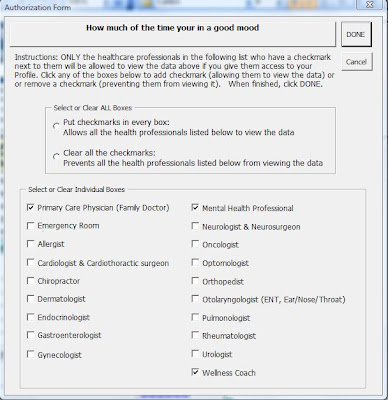
click to enlarge
By clicking the boxes on the form, new types of providers can be added for authorization, and existing providers can be removed.
What would happen, however, if the person wants to remove the authorization of a provider, but such an action would be unwise since that information could help that provider make better decisions and deliver needed care? The PHPro is designed to give warnings and alerts should this happen. A warning prevents the person from removing the authorization of a certain type of provider when a particular piece of information is absolutely essential, while an alert advises the person not to remove the authorization, but allows the individual to override the alert and remove the authorization anyway.
The following screenshot shows an alert. In this example, the person chose not to allow his/her primary care physician to see information about a serious stomach problem. Since it is inadvisable, a message box appears issuing an alert, which can be over-ridden by the person.
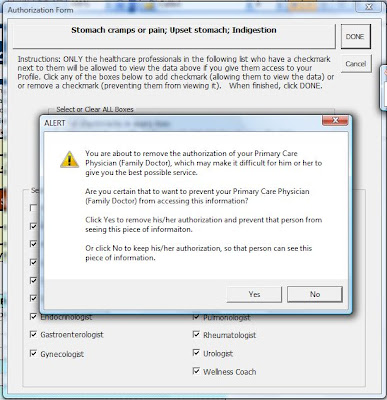
click to enlarge
This is an innovative way to give consumers granular level control over their PHI. Note that the list of provider types can be expanded or contracted easily, and the rules logic for pre-authorizing particular limited data sets can modified as necessary.
I'll now describe how our Personal Health Profiler™ (PHPro™) does it.
Following is a screenshot of a small section of the PHPro report. On the left there are little button colored red, green, and yellow:
- The little RED button in the left-hand column (displaying a closed lock) means only the consumer is permitted to view the data on that row; it is locked from everyone else.
- The little GREEN button (displaying an open lock) means the consumer has authorized certain types of providers to view the data on that row.
- The little YELLOW button (also displaying an open lock) means the data have been pre-authorized for certain people to view using rules logic.

click to enlarge
To see who is permitted (authorized) to see particular data, or to change the permissions, the person clicks the left of that item. The following Authorization Form then appears:

click to enlarge
By clicking the boxes on the form, new types of providers can be added for authorization, and existing providers can be removed.
What would happen, however, if the person wants to remove the authorization of a provider, but such an action would be unwise since that information could help that provider make better decisions and deliver needed care? The PHPro is designed to give warnings and alerts should this happen. A warning prevents the person from removing the authorization of a certain type of provider when a particular piece of information is absolutely essential, while an alert advises the person not to remove the authorization, but allows the individual to override the alert and remove the authorization anyway.
The following screenshot shows an alert. In this example, the person chose not to allow his/her primary care physician to see information about a serious stomach problem. Since it is inadvisable, a message box appears issuing an alert, which can be over-ridden by the person.

click to enlarge
This is an innovative way to give consumers granular level control over their PHI. Note that the list of provider types can be expanded or contracted easily, and the rules logic for pre-authorizing particular limited data sets can modified as necessary.
Friday, November 14, 2008
Announcement: Released First Open Source Program
Regular readers of this blog are probably aware that I've had lengthy, and sometimes heated, debates with leaders of the open source community about the value of having both free open source software (FOSS) and proprietary software systems. I made the case that inventors who hold patents for truly original and useful breakthrough software programs—and who are compassionate, empathetic, socially-minded individuals—should not be lumped together with people who receive software dubious patents for insignificant inventions. These latter inventors sole purpose is to enrich themselves by "holding other developers hostage" and constraining them from creating health information technology programs that could have great benefit for the greater good. And I fully support FOSS for taking a hard-line stand against such practices!
I made the case, therefore, that FOSS programs, and proprietary programs offered by decent inventors, can live together peacefully for everyone's benefit. For more, see this link to one of my other blogs.
I now want to announce that I've just offered a data conversion program under a free open source license. For anyone interested, it's located at this link: http://opensourceandpatents.blogspot.com/2008/11/first-open-source-offering-xml-to-csv.html
Subscribe to:
Posts (Atom)